
Old Trafford Extinction Event
Stadium Replacement Economics

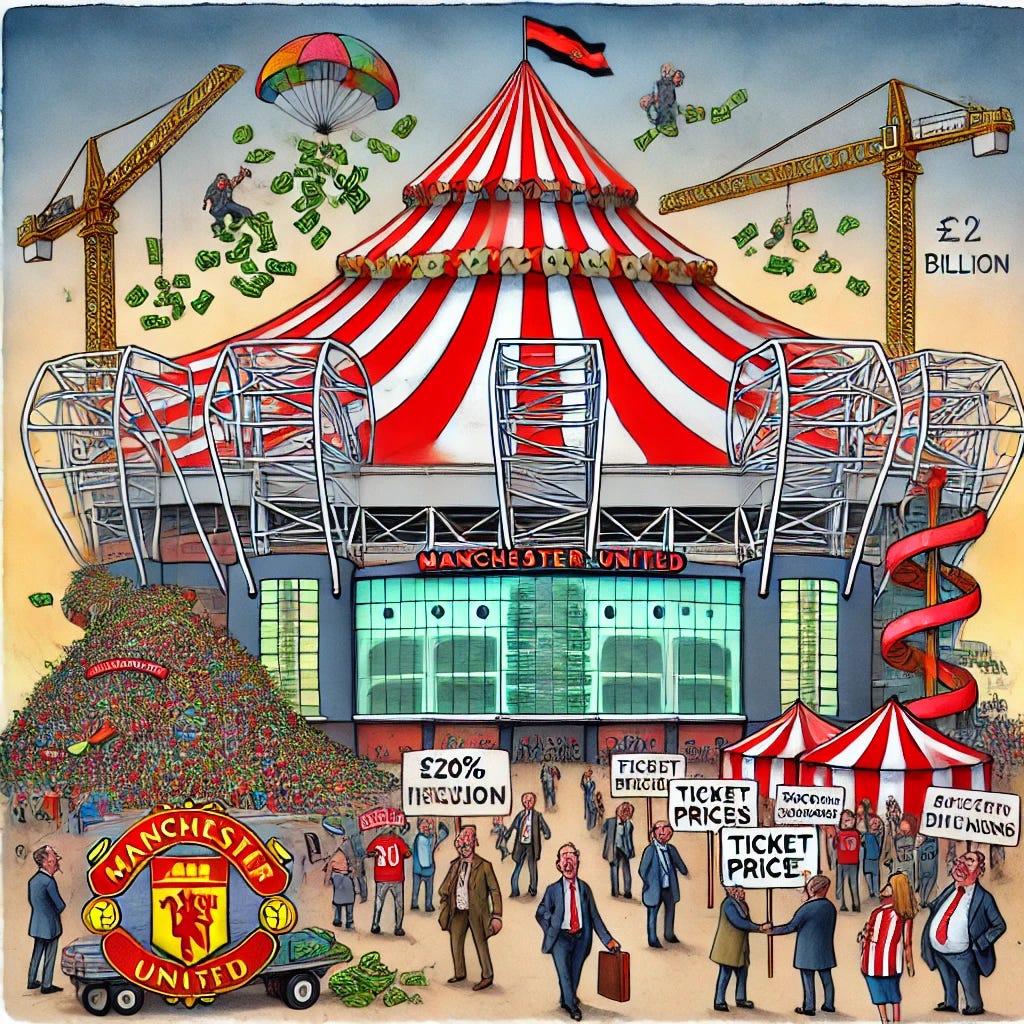
The announcement of Manchester United's plans to demolish Old Trafford and construct a brand new 100,000-seat stadium represents football's most dramatic architectural pivot since Tottenham discovered they could charge £15 for a pint. This £2 billion erasure and replacement strategy marks United's transition from "we might fix the leaks eventually" to "let's bulldoze the entire problem," combining the subtlety of a wrecking ball with the price tag of a small country's defense budget.
After nearly two decades of treating Old Trafford maintenance like an optional software update, the club has unveiled a replacement strategy that reads like a Silicon Valley disruptor's approach to heritage: when the product has too many bugs, discontinue it entirely and release version 2.0. The demolition of a 115-year-old cultural landmark in favor of a shiny new 100,000-seat colosseum demonstrates either bold visionary thinking or the ultimate admission that neglect has rendered renovation impossible – rather like deciding it's easier to buy a new house than clean the current one.
The Economics of Heritage Deletion
The financial architecture behind this stadium replacement reveals more about United's priorities than any club statement ever could. After directing £855m to interest payments and £154m to dividend extractions between 2006-2023, the club has concluded that the most economical solution to decades of neglect is complete obliteration. The £2 billion budget represents the most expensive admission of maintenance failure in sporting history, creating a new metric in football economics: the Neglect-to-Replacement Ratio (NRR), where every £1 saved on upkeep eventually costs £20 in replacement.
The decision to expand capacity to 100,000 seats introduces another fascinating economic concept: the Attendance Aspiration Gap (AAG), where stadium capacity increases in inverse proportion to recent on-field success. This approach creates the unique scenario where United could simultaneously fail to qualify for the Champions League while hosting the largest weekly gatherings in European club football – a bit like building a mega-church while the congregation is losing faith.
The economic implications extend well beyond construction costs into the realm of heritage valuation. By demolishing rather than preserving Old Trafford, the club has effectively quantified the market value of tradition at exactly zero, creating a new entry in accounting textbooks: Nostalgia as Liability (NaL). The financial calculation appears straightforward: memories don't generate premium hospitality revenue, while luxury boxes absolutely do.
Fan Financing Through Anticipatory Pricing
The recently announced 20% ticket price increase demonstrates United's innovative approach to project pre-financing, requiring supporters to fund a stadium they currently cannot see, may never see completed, and which destroys the one they've loved for generations. This pricing strategy creates yet another economic innovation: the Demolition Premium Model (DPM), where fans pay more to witness the corporate equivalent of a Viking funeral for their spiritual home.
The average season ticket will rise from £600 to £720 for the privilege of watching both the team and the stadium enter a transitional period of uncertain quality. The club's justification for this increase demonstrates remarkable linguistic gymnastics, citing "future-focused infrastructure investment" and "capacity-driven experience enhancement" – corporate language that translates roughly to "we're knocking down your cathedral and you're paying for the bulldozers."
A comparative analysis reveals that United's new pricing structure will make watching football in a partially demolished environment the third most expensive stadium experience in European football, creating a price-to-nostalgia ratio that economists might study for generations – assuming economists occasionally experience human emotions.
From Theatre of Dreams to Circus Maximus
The architectural renderings of the new stadium have provoked passionate fan reaction, with many observing that the proposed design bears a striking resemblance to a circus big top – creating the impression that the club has confused "world-class sporting venue" with "Cirque du Soleil permanent installation." This design approach introduces another economic concept: Architectural Identity Displacement (AID), where iconic historic structures are replaced with generic contemporary designs that could exist literally anywhere.
The circus tent aesthetic creates an unintentional metaphor for modern football's entertainment priorities, where sporting competition increasingly resembles a carefully choreographed spectacle designed for global broadcast consumption. The new stadium's design brief called for creating a "world-class, forward-looking venue that respects the club's heritage" – architectural language that attempts to bridge the gap between heritage and demolition with all the logical consistency of claiming to preserve a forest by cutting down all the trees.
The capacity expansion from 74,000 to 100,000 seats represents United's ambition to create the "Wembley of the North," though with marginally better transport options and significantly more expensive catering. This approach to stadium design prioritizes raw capacity over atmosphere, potentially creating the world's largest library on matchdays against mid-table opposition. The acoustics will allegedly "amplify fan noise," though this technology will be thoroughly tested during the inevitable periods of stunned silence following defensive errors.
Premium Extraction Model 2.0
The new stadium's internal configuration reveals the project's true financial engine, with approximately 40% of the footprint dedicated to premium experiences despite accounting for only 20% of the seat count. The economics of modern stadium design have evolved from "how many fans can we accommodate?" to "how many different tiers of expensive hospitality can we create?" – transforming the goal of stadium architecture from containment to stratification.
The proposed luxury facilities include 400 executive boxes (up from 156), 28 "ultra-premium clubs" with field-level viewing experiences, and 12 "heritage suites" named after club legends who would likely need season loans to afford entry. The Bobby Charlton Premium Club promises an "authentic connection to United's history" from comfortable seats that bear no resemblance whatsoever to anything Bobby Charlton experienced, creating a revenue opportunity best described as "nostalgia at platinum prices while erasing the actual nostalgia."
This hospitality-focused approach transforms the football stadium from sporting venue to corporate entertainment platform, where the quality of the networking matters more than the quality of the football. The projected £238m annual revenue from premium facilities would fund approximately 2.8 Antony-caliber signings each year, proving that sometimes the most valuable transfers occur from standard seats to corporate boxes that include "complimentary" champagne at £200 per seat.
Demolition Economics: The Cost of Erasure
The economics of demolishing Old Trafford deserve special analysis, combining the practical costs of destruction with the incalculable cultural loss of erasing a historic landmark. The physical demolition budget of £80m represents the most expensive symbolic gesture since the European Super League announcement, though with marginally better public relations management.
The physical process will require dismantling 115 years of history with all the sentimentality of a quarterly earnings report. The demolition phase creates another economic metric: the Heritage Destruction Efficiency Ratio (HDER), where generations of memories are converted into rubble at a rate of approximately £695,652 per day. Some stadium components will allegedly be "preserved and incorporated" into the new structure, creating the architectural equivalent of keeping your grandmother's ashes in a modernist urn designed by someone who never met her.
The demolition represents perhaps the most literal example of the Glazer ownership approach: acquiring a beloved institution, extracting maximum value while minimizing investment, and ultimately replacing it with something more commercially efficient. This creates a perfect case study in stakeholder capitalism versus shareholder capitalism, where the economic value of tradition competes with the financial efficiency of replacement – a contest with predictable results when quarterly returns drive decision-making.
Future-Proofing Through Replacement
The new stadium's design brief highlights its "future-proofed" capabilities – architect-speak for "this one has functional plumbing and a roof that keeps water out." The promised technological integration includes stadium-wide 6G connectivity, biometric admission systems, and augmented reality viewing enhancements, creating an experience that combines the charm of attending live sport with the invasive surveillance of a high-security government facility.
This technological approach represents United's most ambitious modernization since discovering that football clubs occasionally need to invest in infrastructure. The digital capabilities will allow fans to order overpriced refreshments directly to seats they can no longer afford, while simultaneously watching replays of goals scored by players purchased at inflated fees due to United's notorious negotiating strategy of "yes, we'll pay whatever you initially asked plus a little more just to be sure."
The environmental sustainability features of the new stadium demonstrate the remarkable economic principle that it's easier to build a new eco-friendly structure than convert an existing one – rather like buying a Tesla instead of maintaining your current vehicle. The proposed carbon-neutral design includes solar panels, wind turbines, and ground-source heat pumps, creating what marketing materials describe as "the most sustainable stadium in world football" but what might more accurately be called "offsetting the massive carbon footprint of demolition and reconstruction with some nice green technology."
Construction Timeline Fantasy
The proposed construction timeline represents a masterclass in optimistic projection, with completion scheduled for 2029-30 despite comparable projects suggesting 2032-33 as more realistic. This creates a unique spectator experience where fans can trace their children's development against construction progress: "Little Emma was in primary school when they demolished the Stretford End, and now she's completing her doctorate as they install the last seats."
The phased demolition and construction approach creates another innovative economic concept: the Nostalgia Gradient, where fans can watch their history disappear section by section while ticket prices increase inversely to the amount of heritage remaining. The promised "continuity of matchday operations" during construction translates roughly to "we'll keep playing somewhere in Greater Manchester, but the atmosphere might more closely resemble a corporate team-building event than a football match."
The timeline's ambitious nature suggests either remarkable confidence in construction management or a fundamental misunderstanding of how long it takes to build anything in the UK. The projected completion date has the same relationship to reality as transfer rumors do to actual signings – they sound plausible until you apply basic critical thinking.
Economic Ripple Effects
The broader economic implications of United's stadium replacement extend well beyond the club's balance sheet, creating ripple effects across multiple sectors with all the predictability of a Luke Shaw injury. The local economy will experience the "Stadium Construction Paradox" – increased economic activity coupled with the loss of a historic landmark that defined the area's identity.
The project's impact on Manchester's broader economy demonstrates the modern football club's evolution into regional economic engine. The promised 7,500 construction jobs and 2,200 permanent positions represent both genuine employment opportunity and useful political cover for the heritage destruction and ticket price increases funding them. The construction supply chain will extend across 232 companies in 24 countries, transforming what was once a local football club into a multinational construction consortium that occasionally plays football.
Perhaps most significantly, the stadium replacement project marks a definitive philosophical shift in how football clubs view their physical assets – from historically significant community institutions to commercially optimized entertainment venues with expiration dates. This transition raises questions that keep both economists and philosophers awake at night: what is the true value of tradition in the modern game, and at what point does a club become a brand with a team attached rather than a team with a brand attached?
Financial Engineering Metrics (2025-2032)
Project Budget: £2 billion (More than the combined GDP of several island nations)
Actual Expected Cost: £3.2 billion (Based on similar mega-project overruns)
Old Trafford Demolition Cost: £80m (The price of erasing history)
Ticket Price Increase: 20% (Effective immediately for benefits arriving in 2032)
Construction Timeline: 5 years official, 8.3 years reality
Maintenance Savings vs. Renovation: -£420m (Demolition costs more than fixing!)
Financing Cost: £840m (Interest payments that could fund a forward line capable of finishing)
Fan Contribution: £520m (Through the innovative "pay more for nothing" ticketing strategy)
Premium Hospitality Revenue: £238m annually post-completion (The true priority revealed in numbers)
Heritage Value Written Off: Incalculable (But apparently less than zero on the balance sheet)
Nostalgia Preservation Budget: £35m (For some bricks in a museum and plaques nobody will read)
Official Renderings Produced: 1,742 (Each more circus-like than the last)
Fan Consultations: 12 (Each less influential than the previous one)
Corporate Partners Consulted: 247 (Each more influential than all fans combined)
UNITED Index Rating:
ROI: +7 (Maximum commercial extraction potential)
ROP: +3 (Performance impact remains theoretical until someone signs a defensive midfielder)
RFG: +4 (Short-term capital expenditure for long-term dividend enhancement)
Overall UNITED Rating: +4.7 (The Most Expensive Memory Erasure in Sporting History)
See also: Heritage Destruction Economics, Nostalgia Monetization Strategy, Construction Timeline Elasticity, Premium Hospitality Ecosystem, Demolition-Based Innovation, Circus Architecture Theory, Fan Sentiment Arbitrage